Drone Policy: The Shift From Hardware to Compliance
Four drone-policy stories broke the same week. Read apart, they're unrelated news. Read together, they show the same shift in who actually wins.
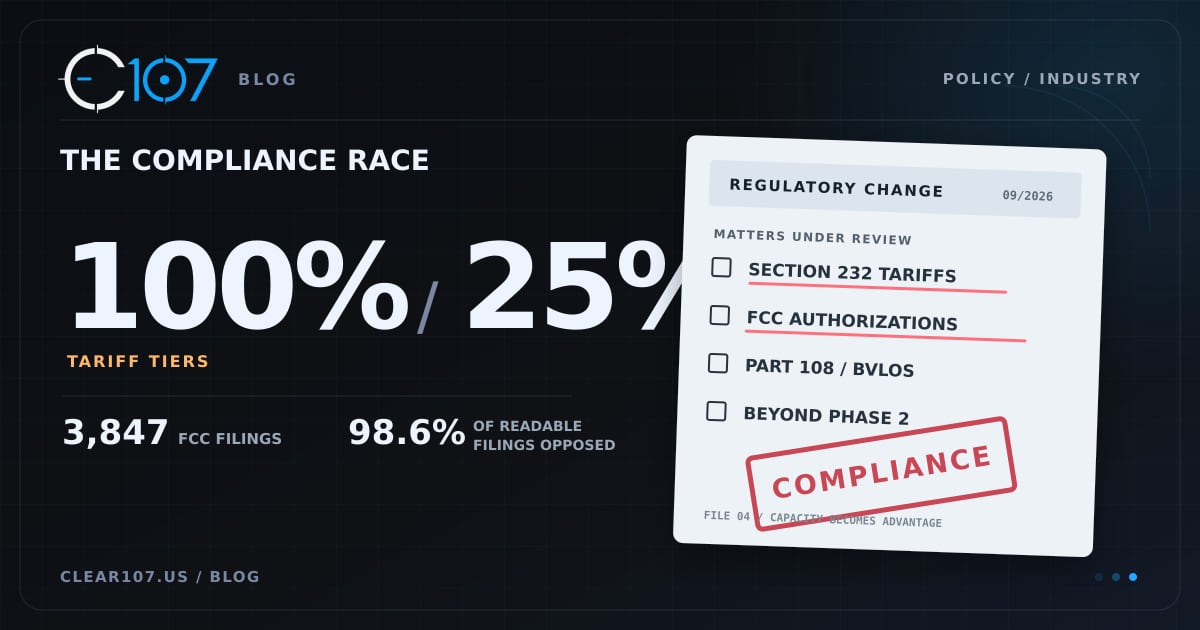
Four drone-policy stories broke in the same week: new import tariffs, an FCC push to revoke drones' equipment authorizations, the FAA's BVLOS rule stuck at the White House, and a new FAA testing program meant to look like BVLOS progress. Read individually, they're four unrelated news items.
Read together, they point at the same shift: the operators who gain ground aren't necessarily the ones with the best aircraft. They're the ones who can absorb certification cost, legal complexity, and regulatory relationship-building. That's a different competitive axis than the one most Part 107 pilots are trained to think about.
Tariffs: a policy that may entrench the market it's meant to challenge
New Section 232 tariffs took effect September 3, 2026.
100%
tariff on drones over 55 lbs, thermal-equipped drones, and docking stations
25%
tariff on standard small drones without those capabilities
The straightforward read is "prices go up." The more interesting version: on the 25% tier, if the market leader does what it has historically done and simply absorbs the tariff rather than raising prices, the policy meant to help U.S. manufacturers instead denies them the sales volume needed to compete on price at all. The 100% tier is where the incentive is sharpest: it doesn't just tax integrated thermal drones, it creates a specific reason to stop building them as integrated products and start selling modular, snap-on thermal payloads instead. That's a plausible response to the incentive, not a confirmed one, so treat it as a prediction, not a fact in evidence yet.
The FCC docket: precision matters more than the headline suggests
The FCC's proposal to pull back equipment authorizations for seven categories of "military-grade" drones (aircraft over 55 lbs, agricultural spraying drones, thermal-camera platforms, LiDAR-equipped drones, docking stations, defense-equipment-carrying drones, and swarming or light-show drones) drew a record public response.
3,847
public comments filed in FCC docket PS 26-189
98.6%
of readable filings opposed the proposal
DJI's own comment was signed by a former U.S. Solicitor General, a signal that the company is treating this as more than a routine regulatory filing. But the accurate version of the threat is narrower than "your drone gets grounded": what's actually on the table is revoking authorization to sell these categories going forward, not a mandate that already-purchased, already-operating aircraft stop flying. That distinction matters for anyone currently deciding whether to buy. One effect worth watching for, though this is analysis, not a confirmed outcome: a drone whose future legal-sale status is uncertain could become harder to finance, insure, or resell, and that kind of risk tends to land hardest on operators who can least absorb it, not the ones with fleets and compliance departments.
Part 108: the "we might need to change it later" excuse doesn't hold up
The FAA's Part 108 (BVLOS) rule has sat at the White House's Office of Information and Regulatory Affairs since July 10, past the FAA's own internal target. Officially, the delay is deliberate: officials don't want to lock the industry into technical requirements that could become obsolete. That reasoning doesn't survive its own logic: Part 107 itself has been amended multiple times since 2016 without anyone treating "we might need to revise this later" as a reason not to finalize it in the first place.
The more useful question is who structurally benefits from BVLOS staying unresolved, not who's causing the delay on purpose: the handful of companies that already went through the individually-negotiated waiver process to get BVLOS rights. A published, qualify-by-meeting-standards rule would let smaller competitors reach the same access those companies spent years and legal budgets earning. Every month of delay is a month that earlier investment keeps paying off as a moat instead of becoming a sunk cost, regardless of whether anyone at DOT intends that effect.
There's a real counter-consideration worth naming honestly: BVLOS rulemaking also involves genuinely unresolved technical fights, like detect-and-avoid and right-of-way standards, and it's entirely possible the delay reflects real disagreement on those, not incumbent protection at all. Both can be true at once, and nothing here should be read as a claim about anyone's intent.
BEYOND Phase 2: a different kind of story than the other three
The FAA's invitation for up to 8 new government partners to join BVLOS testing, landing the same week Part 108 stalled at the White House, reads to some as proof of momentum and to others as a way to look like momentum exists while the actual rule doesn't move. This one doesn't fit the other three as cleanly, and it's worth being honest about that: BEYOND Phase 2 is a testing-access pathway, not a market barrier the way tariffs or an authorization review are. State and local governments front the program, but they typically execute it by partnering with private operators, so it isn't strictly true that only large institutions benefit from the flying itself. What is true is that applying for, and then operating inside, a federal testing agreement takes staff, legal capacity, and time that a two-person mapping company doesn't have lying around, so access to the program itself still sorts by institutional capacity even if the eventual flight hours get shared more broadly.
The pattern underneath the first three, and the limits of it
Tariffs, the FCC authorization review, and the Part 108 delay share a real structural pattern: in each case, the party best positioned to absorb the policy, a tariff hike, a compliance uncertainty, a multi-year rulemaking delay, already has scale, legal capacity, or an existing regulatory relationship, whether or not that's anyone's intent. BEYOND Phase 2 belongs to the same week's news, and the same underlying dynamic (institutional capacity as an advantage) shows up in how access to it works, but calling it a "barrier" alongside the other three would be overstating it.
If you're a small Part 107 operator watching all four of these stories from outside, the practical takeaway isn't "the rules are unfair." It's that regulatory relationships and compliance readiness are becoming as much a competitive asset in this industry as flight skill, even if the four stories that broke this week don't all prove that the exact same way.
Free diagnostic
Reading about drones is one thing. Passing the Part 107 test is another. See where you stand.
Take the free 10-minute diagnostic