
Am I Ready for Part 107? A Score Guide
Passing a practice test is not the same as being ready. How to read your scores against the 70% line, the blueprint weights and the margin you want on test day.
Everyone who studies for Part 107 eventually asks the same question: is my score good enough to book the test? The honest answer is that a single number rarely tells you, and the way most people read their practice scores can be off by ten points or more.
The line that matters
70%
the score needed to pass the FAA knowledge test
60
questions on the test, with a two-hour limit
Those are the FAA's numbers. Everything below is about how a practice score relates to them.
Why passing a practice test is not a green light
A practice score of 72% clears the line on paper and still tells you very little. A few reasons:
- The questions are different. Every practice bank is written by someone other than the FAA. Familiar phrasing on a practice test can hide gaps that a differently worded question exposes.
- Not every real question counts, and you cannot tell which. The real test may include unscored pretest items, and it does not mark them, so you cannot ease off on any question.
- Test day is not practice day. Time pressure, a testing room, and a first attempt at chart questions all cost something.
- One run is a sample. A single 72% could be a good day or an average one.
That is why a margin matters more than the line itself.
The blueprint changes what a score means
The FAA's updated test blueprint, effective September 29, 2025, weighs the areas unevenly: Regulations 48%, Operations 25%, Airspace 20%, Weather 5%, Loading and Performance 2%. That means the average you get from adding up your area scores and dividing by five is the wrong number. Weight it.
| Scenario | Flat average | Weighted by blueprint |
|---|---|---|
| 55% in Regulations, 95% in every other area | 87% | 76% |
| 20% in Weather, 85% in every other area | 72% | 82% |
The first candidate looks strong on a flat average and is close to the line once Regulations count for what they are worth. The second looks marginal on a flat average and is comfortable, because Weather barely moves the total.
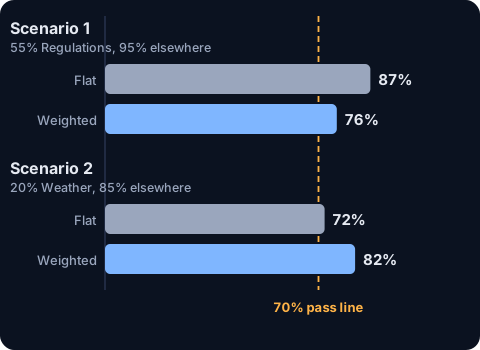 Bar chart: scenario one scores 87% flat and 76% weighted, scenario two 72% flat and 82% weighted, with a 70% pass line
This is illustrative arithmetic on the blueprint weights, not a prediction. The blueprint describes the mix of scored content, and the FAA does not promise an exact question count for each area on every test form.
A rule of thumb, clearly labeled as ours
The FAA gives no readiness formula, so what follows is our own guideline and nothing more. It is not an FAA standard, and we have not tested it as a predictor of real results.
- Several full timed runs, on different days, each comfortably above 70%. We would want a margin of around ten points, so 80% or better, before booking.
- No area that collapses, especially Regulations and Operations. Together they are 73% of the blueprint. Read your weakest area first, not your average.
- Misses that change from run to run. Missing different questions each time is noise. Missing the same topic again and again is a concept gap, and it will show up on the real test.
Reasons to wait: one strong run after several weak ones, a score that drops when you switch to a different question bank, or a weak area you keep meaning to get to.
A score above 70% in practice says you might pass. A margin, across several runs and every major area, says you probably understand the material.
This is a study signal, not a forecast
A practice score, on any platform including ours, is a study signal. It is not an FAA prediction, and no practice result guarantees a pass. If you book and the test goes badly, the retest wait is 14 days, and your score report will show which areas to fix. For how hard the test really is, see is Part 107 hard.
Before you book
Confirm your logistics with the test day checklist. If you need a structure for the weeks ahead, the two-week study plan is one option.
The free diagnostic scores you against the current blueprint weighting instead of a flat average. It is a starting point for the plan above, not a verdict.
Get a blueprint-weighted baselineFree diagnostic
Reading about drones is one thing. Passing the Part 107 test is another. See where you stand.
Take the free 10-minute diagnostic