Part 107 Test Day: What to Bring and Expect
Your FAA Tracking Number, the right ID, what the testing center provides, what you cannot bring, and what happens after you pass, in the order you meet them.
Most of the stress around test day is logistics, not content. Candidates who know the material still get turned away over paperwork, or spend the first ten minutes of a two-hour test wondering what they are allowed to use. This is the whole sequence in order, from booking to the certificate.
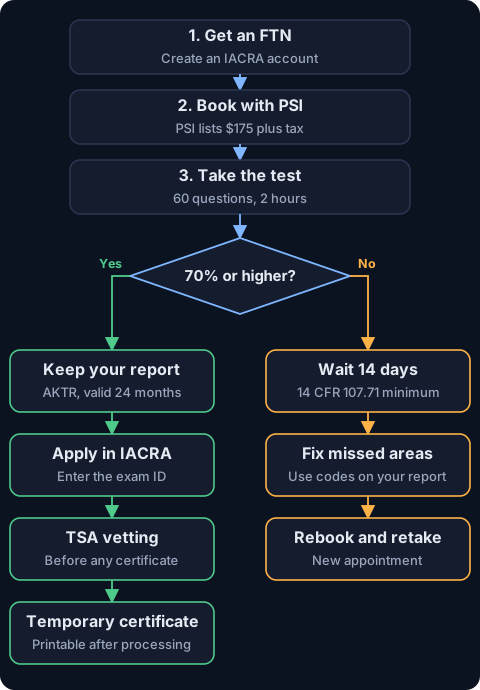 Flowchart from FTN and PSI booking to the test, then IACRA and TSA vetting if you pass or a 14 day wait and retake
Before you can book
If you are unsure whether your flying needs Part 107 at all, see Do You Need Part 107? before you pay for a test. You need an FAA Tracking Number first. Create an IACRA account, get your FTN, and enter it when you register with PSI, the testing provider. PSI checks it before it lets you schedule.
On age, the FAA testing matrix lists 14 as the minimum age to sit the UAG test, while 14 CFR §107.61 requires you to be at least 16 to hold the remote pilot certificate. A 15-year-old can pass the test but cannot get the certificate yet.
PSI listed the FAA knowledge test at $175 plus applicable tax as of September 17, 2026. Prices can change, so check PSI when you book. More on cost is in the exam cost guide.
What to bring
The requirement is one valid, current ID that shows all four of these: your photo, your date of birth, your signature, and your physical residential address. For U.S. citizens and resident aliens the FAA lists items such as a driver license or state ID, a U.S. government or military ID, a passport, or an alien residency card. Non-U.S. citizens generally need a passport plus a qualifying government-issued ID.
The four-element rule catches people. A license without your current street address does not meet it on its own, and FAA guidance allows presenting more than one document to cover everything. Check your ID against all four items well before the appointment, not at the counter.
What is provided, and what is not
The testing center provides the FAA test supplement book, which holds the charts and figures the questions refer to, and scratch paper. You cannot bring your own notes, printed charts, a phone, or any other written, printed, or electronic reference material into the testing area.
FAA rules do permit certain aviation-related test aids, such as plotters, navigation computers, and aviation-oriented calculators. The exact policy for a specific device can differ, so ask PSI about the specific item before test day rather than assuming it is fine.
The test itself
60
questions on the FAA UAG knowledge test
2 hours
allowed, which works out to about two minutes per question
You need 70% to pass. The test may also include a few unscored pretest questions, and it does not mark which ones they are, so answer every question as if it counts. Two minutes per question is generous for most items. The time goes on the chart and scenario questions, so if one stalls you, flag it, move on, and come back.
After you finish
Your Airman Knowledge Test Report lists ACS codes for the areas you missed. Keep it either way: a passing report is generally valid for 24 calendar months for completing your certificate application.
If you passed, the next steps happen online:
- Complete the remote pilot certificate application in IACRA and enter the knowledge test exam ID from your report when prompted.
- The TSA completes security vetting. The FAA issues a temporary or permanent certificate only after that clears.
- After successful processing, IACRA gives you access to a printable temporary certificate. It does not appear the moment you pass, so plan for some waiting.
If you did not pass, see what happens next: the retest wait is 14 days, and the report you just received tells you where to spend them.
The free diagnostic gives you a baseline scored against the current exam blueprint. It is a starting point, not a verdict, and the [readiness guide](/blog/am-i-ready-part-107-score-guide) explains how to read your scores against the 70% line.
Check where you stand before you bookFree diagnostic
Reading about drones is one thing. Passing the Part 107 test is another. See where you stand.
Take the free 10-minute diagnostic