The Most Common Part 107 Exam Mistakes in 2026
Most candidates study Part 107 by feel: heavy on the scary topics, light on the ones that actually carry the exam. The FAA's blueprint says otherwise.
Ask someone what the Part 107 knowledge test covers and most say "the regulations." That's not wrong, but it's a rounding error away from the actual answer, and the gap between the two is exactly where most study time gets wasted.
The test is also not the formality some candidates treat it as. FAA airman knowledge testing data puts the UAG pass rate at roughly 83%, with an average score around 79%, across close to 74,000 test-takers in the most recent reporting year. About one in six candidates doesn't pass on the first attempt, on a test most people assume is mostly memorization.
The exam isn't weighted the way it feels. Candidates over-prepare the topics that sound technical and under-prepare the ones that actually carry the score.
What the blueprint actually weighs
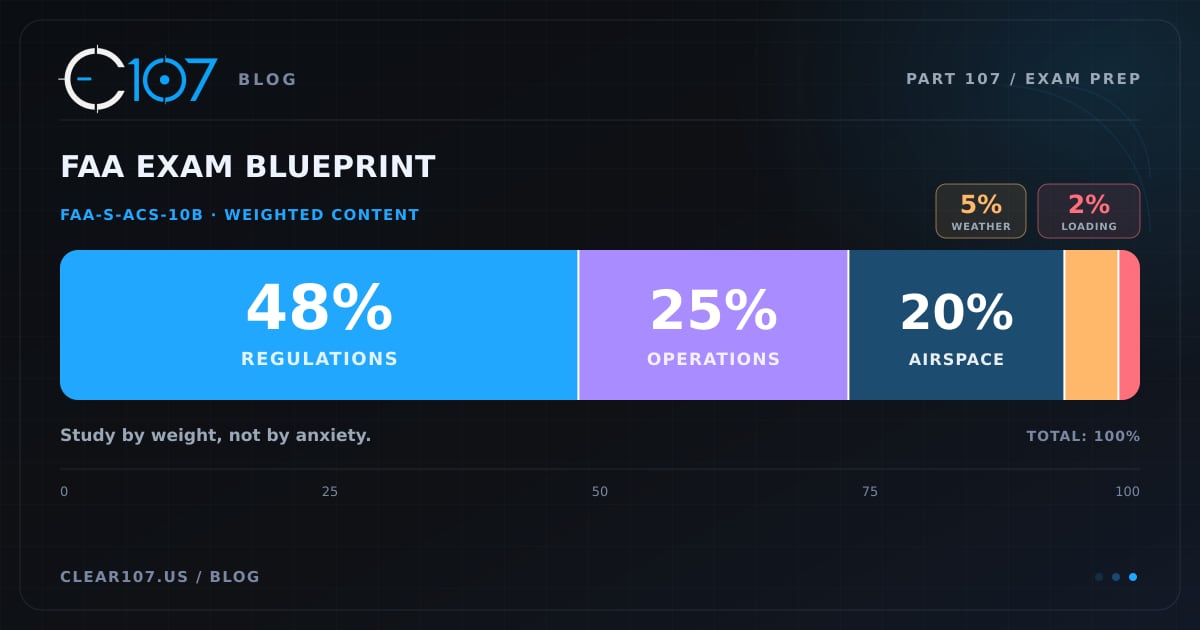
The FAA-S-ACS-10B blueprint splits the UAG knowledge test into five areas, and the split isn't close to even:
48%
of the exam is Regulations
25%
of the exam is Operations
20%
of the exam is Airspace
5%
of the exam is Weather
2%
of the exam is Loading and Performance
Regulations and Operations alone account for 73% of the test. Weather and Loading and Performance combined are 7%. If your study time doesn't roughly track that split, you're optimizing for the wrong thing, no matter how thoroughly you study.
Why candidates lose points: four structural traps
Not all study missteps carry the same weight. The vast majority of avoidable score drops cluster around two load-bearing errors — mishandling the massive Regulations block and dismissing Operations as common sense — while over-investing in minor technical details rounds out the rest.
- Treating "regulations" as an undifferentiated pile: Accounting for 48% of the test, it is tempting to simply read Part 107 from start to finish. In reality, the testable surface centers tightly on specific mechanics like operating limitations (14 CFR §107.51: maximum groundspeed, altitude, and visibility/cloud clearance requirements), waivers, registration, and remote pilot certification. Skimming the text without mastering scenario-based limitations leaves the single largest exam block exposed.
- Shortchanging Operations as "common sense": Making up 25% of the test, emergency procedures, crew resource management, aeronautical decision-making, and physiological effects are routinely neglected because they sound intuitive. The exam tests precise scenario reasoning rather than abstract intuition, turning this second-largest category into a quiet point sink.
- Studying airspace like flat fact-recall: Representing 20% of the exam, airspace requires actual chart-reading agility under time pressure — identifying whether specific charted points require authorization — rather than rote memorization of airspace classes.
- Over-indexing on weather and loading: Though weather (5%) and loading/performance (2%) feature the most jargon-dense math and acronyms (METARs, TAFs, density altitude), spending disproportionate study time here trades points you are likely to lose for points that barely move your final score.
None of this means skip weather or loading. It means study them in proportion to what they're actually worth on the test, not in proportion to how technical they sound.
The handbook is organized by the same five ACS areas this post is, letting study hours map directly to the official blueprint instead of a course's own module structure.
Clear107's free diagnostic scores you against the real blueprint weighting, not a flat average, so you know which of the 73% you're actually behind on.
Find your actual weak areasFree diagnostic
Reading about drones is one thing. Passing the Part 107 test is another. See where you stand.
Take the free 10-minute diagnostic