Do You Need Part 107? Ten Real Scenarios
Where recreational flying ends and Part 107 begins, using the FAA's own examples and a clear line between what the FAA says and what we infer.
The question most new pilots ask is "am I getting paid?" The FAA does not ask that. Whether a drone flight is recreational depends on the purpose of that specific flight, and payment is only one way to end up outside the recreational exception.
This post walks through ten scenarios. The first five are FAA examples. The last five are cases where the FAA states the principle but not the exact case, and we say so each time. For a side-by-side of the two paths, the Part 107 vs recreational page is the short version.
The rule in one paragraph
Under 14 CFR §107.1, Part 107 applies to civil small drone operations in the United States, with an exception for flights covered by the recreational exception in 49 U.S.C. §44809. The FAA describes Part 107 as the default for drones under 55 pounds, and says almost all non-recreational drone flying falls under it. To use the exception, a flight must be only for recreational purposes, and the pilot must follow the safety guidelines of an FAA-recognized community-based organization, keep the drone in visual line of sight, stay at or below 400 feet in uncontrolled airspace, get authorization to fly in controlled airspace, pass the TRUST test, and carry proof of it. The exam covers this distinction under UA.I.A.K1.
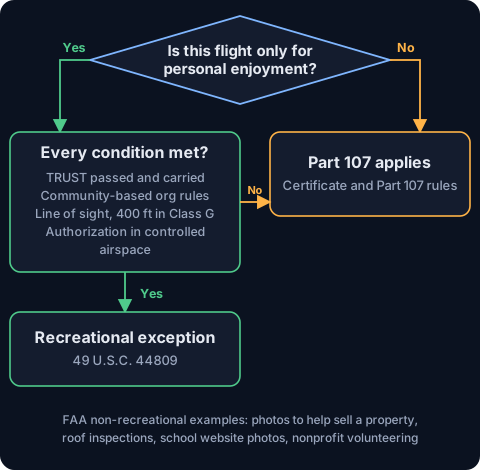 Flowchart: personal-enjoyment flights meeting every condition use the recreational exception; all others fall under Part 107
What the FAA says outright
1. Flying for fun. A flight only for personal enjoyment can use the recreational exception, with TRUST and the other conditions above. No Part 107 certificate is needed for that flight.
2. Photos to help sell a property or service. This is Part 107. The FAA's example is not conditioned on payment, so listing photos for a friend's house, taken for free, still count as a flight to help sell a property.
3. A roof inspection. Part 107. The FAA lists it as a non-recreational example.
4. Photos of a high-school football game for the school's website. Part 107. The purpose serves the school, not your own enjoyment.
5. Volunteering to survey a coastline for a nonprofit. Part 107. The FAA counts goodwill work as non-recreational, so unpaid does not mean recreational.
Where you apply the principle yourself
The FAA says a recreational flight must be only for recreational purposes. These cases are not on its example list, so the answers below are our reading of that principle, not FAA rulings.
6. Promoting your own business, unpaid. A business purpose is not personal enjoyment, even if no client pays you. We read this as Part 107.
7. A monetized YouTube channel. In the sources we checked, the FAA has not published a rule specific to YouTube. The question is whether the flight serves a business. If the channel is a business, or the flight is made for it, treat it as Part 107. If you are unsure, Part 107 is the safe side.
8. An employee flying the company's drone. The company's purpose is not recreation, so this is generally Part 107. The FAA says organizations flying for non-recreational purposes register under Part 107 in DroneZone.
9. School or research flights. The recreational exception is available for educational use only to qualifying institutions of higher education, JROTC programs, and educational programs chartered by an FAA-recognized community-based organization. Other schools fly under Part 107.
10. A hobbyist who later sells a photo. We found no FAA statement that a later sale changes how an earlier flight is classified, and none that lets you choose the purpose after landing. The test is why you flew. If the photos were the point of the flight, treat it as Part 107.
This is general information, not legal advice. Edge cases depend on the specific flight, and the FAA UAS Support Center takes general questions when the FAA's own pages do not cover your case.
What about TRUST if you hold Part 107?
TRUST is a condition of the recreational exception, and it is not listed among Part 107's requirements. So which rules a flight is flown under decides whether TRUST applies to that flight. The certificate itself does not replace the recreational exception's conditions.
Ask "why am I flying?", not "am I being paid?". The FAA's test is purpose.
If you need Part 107
You get the certificate by passing the FAA knowledge test. See the two-week study plan for how to prepare, and the test day checklist for the logistics.
Clear107 explains where recreational flying ends and Part 107 begins, and it is a topic the exam tests directly.
See the two paths side by sideFree diagnostic
Know the rule in theory? See if it holds up under exam conditions.
Take the free 10-minute diagnostic