Drone Delivery's Real Bottleneck Isn't Technology Anymore. It's the Doorstep.
Amazon told Baton Rouge its drones are quieter than a truck. Its own FAA filing puts the delivery hover at 92 decibels. The gap says less about Amazon's spin than about what's actually left to solve before drone delivery scales.
Amazon's Prime Air operations manager in Baton Rouge told a Rotary Club audience this week that the company's delivery drones are quieter than an idling delivery truck, and that flying higher to cut the noise further is the FAA's call, not Amazon's. Both halves of that sentence are checkable against Amazon's own paperwork, and the paperwork doesn't agree with either one cleanly.
The numbers were never hidden. They were just never the ones read out loud in the room.
The claim holds for one number in the filing, not the other
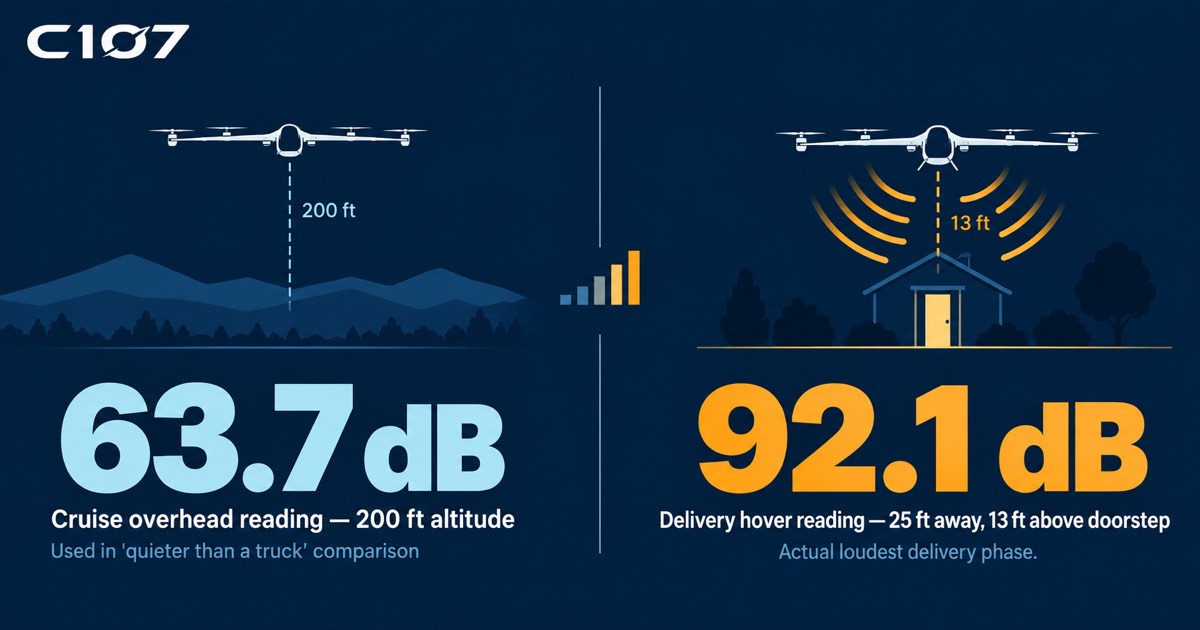
The FAA's environmental noise filing for the Baton Rouge hub gives two very different pictures of the same aircraft.
63.7 dB
the MK30 cruising overhead at 200 feet, the number that supports "quieter than a truck"
92.1 dB
the MK30 at the delivery hover, measured 25 feet away, the loudest moment in the filing
The FAA's own reference points make the split obvious. It compares the 63.7-decibel cruise to an air conditioning unit heard from 100 feet, and the 92.1-decibel figure to a diesel truck at 50 feet or a household vacuum cleaner at 10 feet. On a delivery, the drone descends to about 13 feet above the drop point and hovers there to release the package, which is why the loudest reading in the document is taken close in. Takeoff and landing measure 90.5 and 91.8 decibels at 20 feet, in the same range. The "quieter than a truck" line is accurate exactly while the aircraft is passing overhead, and it inverts the moment the aircraft is doing the part of its job that happens over your yard.
The second half of the claim doesn't hold up either
Pointing at the FAA for the altitude question is the harder part to defend, because Amazon has already shown it doesn't need the FAA's permission to change altitude. Six months before the Baton Rouge comment, Amazon raised its minimum outbound altitude in Richardson, Texas to an average of 225 feet and rerouted some departures over commercial land, after residents there made the same noise complaint. That change happened entirely inside an envelope the FAA had already approved. It required a company deciding to fly a different profile, not a new rule.
None of this makes Baton Rouge's paperwork clean, either. The FAA's own tracking page still lists the site's draft environmental assessment under open-for-review, comment period closed July 22, with no final assessment published. Amazon began commercial service on July 7, fifteen days before that comment period closed. Neither the FAA nor Amazon has publicly reconciled the two dates.
The technology bar was cleared a while ago. This is the bar that's actually left
It's worth being precise about which problem this story is really about, because it's easy to read a story with a decibel number in it as a hardware story. Reliable long-range links and stable delivery-capable airframes aren't the open question anymore; multiple operators have been flying them at real volume for a while now. What's still unresolved is whether the public trusts having them overhead regularly, and that's a different kind of problem than the one BVLOS rulemaking is built to solve.
That argues for scaling the way you'd scale anything people haven't gotten used to yet: gradually, and starting somewhere the exposure is lowest. Industrial parks and low-density service areas are a more defensible place to prove reliability at volume than a residential cul-de-sac is, and a fixed, marked drop zone that residents opt into is a smaller ask than a drone hovering 13 feet over every lawn on the route. Baton Rouge and Richardson are both cases of the harder version: doorstep delivery, in occupied neighborhoods, from day one.
Faster FAA review helps the paperwork side of this. It doesn't touch the trust side. A published, predictable rule under Part 108 would give smaller operators a real path instead of a years-long waiver negotiation, and that's worth wanting on its own terms. But the July 28 national environmental assessment that let Baton Rouge and future hubs skip a site-specific review and public comment period is exactly the kind of regulatory streamlining that can outrun public trust rather than build it: the approval gets easier at the same time the thing local residents actually experience, unannounced hovering close to their homes, hasn't changed. Predictability is most of what's missing on that side. A defined delivery window that residents know about in advance, the way trash pickup or construction noise ordinances work, turns an unpredictable intrusion into a scheduled one, and scheduled noise is a much easier thing for people to live with than noise that could happen at any moment.
What this means if you're building in this space, not covering it
For a Part 107 operator watching this from outside the big delivery programs, the practical read isn't "drone delivery is in trouble." It's that the competitive bar has moved. Getting an aircraft to fly reliably at range stopped being the differentiator once several companies could already do it. What's left to win or lose on is whether an operator's public communication matches its own filed numbers, because that filing is a public document either way, and the operators who lead with the honest version of their own data, on their own terms, are the ones who won't have a local reporter or a Rotary Club audience do it for them first.
Free diagnostic
Reading about drones is one thing. Passing the Part 107 test is another. See where you stand.
Take the free 10-minute diagnostic