Airport Lights and Runway Markings for Part 107
Beacon colors, runway and taxiway lights, hold-short lines and airport signs: what each one means, from the FAA's AIM, and why a drone pilot is tested on them.
A drone pilot should never be on a runway, so why does the Part 107 test ask about runway markings and airport lights? Because they tell you what the airport is doing: whether it is open, whether the weather at the field is below basic minimums, and where aircraft will be. Everything below is from the FAA's Aeronautical Information Manual, chapter 2.
What do airport beacon colors mean?
| Beacon | Meaning |
|---|---|
| White and green | Lighted land airport |
| White and yellow | Lighted water airport |
| Green, yellow and white | Lighted heliport |
| White and green, with two quick white flashes between greens | Military airport |
The AIM adds a detail the test likes: in Class B, C, D and Class E surface areas, a beacon operating in daylight often means the ground visibility is less than 3 miles and/or the ceiling is below 1,000 feet. Three miles is also the Part 107 visibility minimum, so a daytime beacon is a cue to check the weather before you launch nearby.
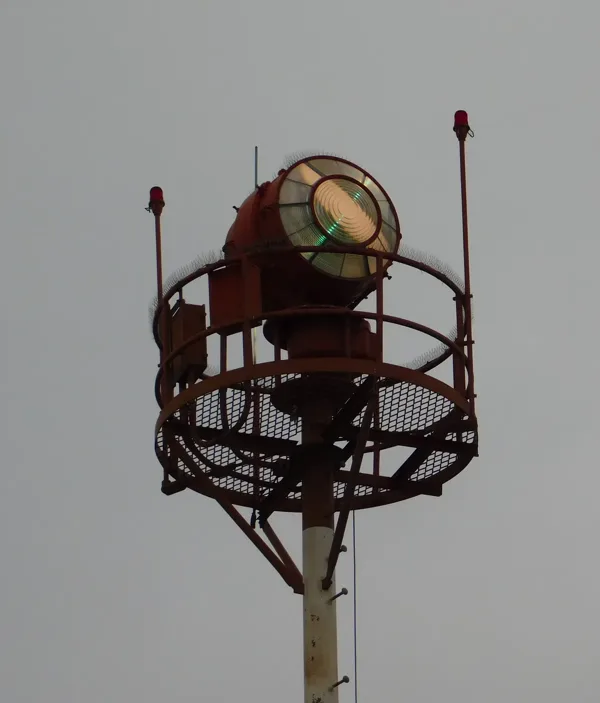 Rotating airport beacon on a tower at San Diego International AirportPhoto: Ruff tuff cream puff, CC0, via Wikimedia Commons
24 to 30
flashes per minute for an airport beacon, per the AIM; 30 to 45 for a heliport
How are runways and taxiways lit?
- Runway edge lights are white. On instrument runways, the last 2,000 feet or half the runway, whichever is less, are yellow as a caution zone.
- Runway end lights show red toward the runway and green outward, marking the threshold for landing aircraft.
- Taxiway edge lights are blue.
- PAPI is a row of two or four lights beside the runway that shows a pilot whether the approach is on the glide path. The AIM says it is usually on the left side and visible from about 5 miles by day and up to 20 at night.
What do the markings on the pavement mean?
The AIM says runway markings are white, while taxiway markings, holding positions and closed or hazardous areas are yellow.
- Runway numbers are the magnetic direction of the runway rounded to the nearest 10 degrees, as the traffic pattern post explains.
- Displaced threshold: white arrows leading to a white threshold bar. The AIM says the pavement before it is available for takeoffs in either direction and for landings from the opposite direction.
- Runway holding position: four yellow lines across a taxiway, two solid and two dashed. The solid lines are always on the side where the aircraft must stop.
- Closed runway: yellow crosses at each end, and on permanently closed runways at 1,000-foot intervals too.
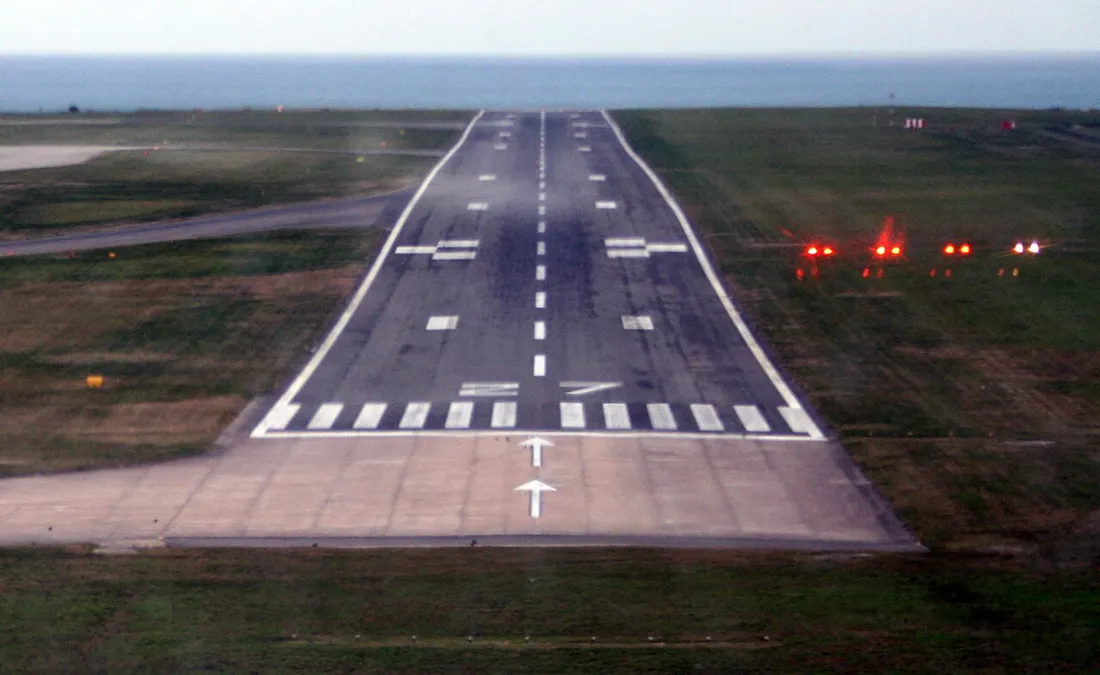 Runway seen on final approach with white threshold markings, displaced threshold arrows and red PAPI lights beside it
A runway on final approach: white arrows before the threshold bar, the white threshold stripes and runway number, and the PAPI lights beside the runway. Public domain, via Wikimedia Commons.
Signs follow a color code. Red with white letters is a mandatory instruction, such as a runway holding position. Black with yellow letters tells you where you are. Yellow with black letters and an arrow tells you which way to go.
Why does any of this matter to a drone pilot?
Because it tells you where manned aircraft will be and when. A runway with its lights on at dusk, a beacon on at noon, a temporarily closed runway marked with crosses: each changes what is likely to fly over your site. The Chart Supplement post shows where an airport's lighting and hours are listed, and the airport operations post covers the radio side.
What the exam asks about lights and markings
The ACS lists runway markings and signage as UA.V.B.K3 and airport and seaplane base lighting as UA.V.B.K8. Expect beacon colors, the meaning of a daytime beacon, the hold-short marking and the sign colors.
White and green is a land airport. A beacon in daylight is a weather warning.
The free diagnostic covers airport operations along with the rest of the blueprint.
Check your operations knowledgeFree diagnostic
Reading about drones is one thing. Passing the Part 107 test is another. See where you stand.
Take the free 10-minute diagnostic