
AGL vs MSL on the Part 107 Test
Part 107 limits are above the ground, while sectional charts mostly print altitudes above sea level. How to tell which is which and convert in one step.
Two altitude references run through the Part 107 test. AGL is height above ground level, and MSL is altitude above mean sea level. The drone rules are written in AGL: 14 CFR §107.51 caps you at 400 feet above ground level. Sectional charts, on the other hand, print most altitudes in MSL. Mixing the two up is one of the most common ways to lose chart points.
Which numbers are AGL and which are MSL?
| Where you see it | Reference |
|---|---|
| Part 107 altitude limit (400 ft, or 400 ft above a structure) | AGL |
| Cloud heights in a METAR or TAF (BKN008 = 800 ft) | AGL |
| Airport elevation in the chart data block | MSL |
| Class B, C and D floors and ceilings on the chart | MSL |
| Top of an obstacle (the first number) | MSL |
| Height of an obstacle (the number in parentheses) | AGL |
| Maximum Elevation Figure in each grid square | MSL |
| Class E floors shown by vignettes (700 or 1,200 ft) | AGL |
The FAA's Chart User's Guide describes the obstacle convention exactly that way: the elevation of the top of the obstacle above mean sea level, and the height of the structure AGL in parentheses below it.
AGL = MSL − ground
the only conversion you need, using the terrain or airport elevation
How do you convert?
Subtract the elevation of the ground under the point from the MSL figure. Three examples from the FAA's test figures:
- Obstacle near Minot, Figure 21: labeled 2447 (690). The top is 2,447 feet MSL and the tower is 690 feet tall, so the ground there is about 1,757 feet MSL.
- Minot Class D, Figure 21: the ceiling box reads 42, or 4,200 feet MSL. The airport elevation is 1,716 feet, so the Class D ceiling is about 2,484 feet above the airport.
- Savannah Class C shelf, Figure 23: labeled 41 over 13. The floor is 1,300 feet MSL. The FAA's sample question offers 1,300 feet AGL as a wrong answer, and that is exactly the trap.
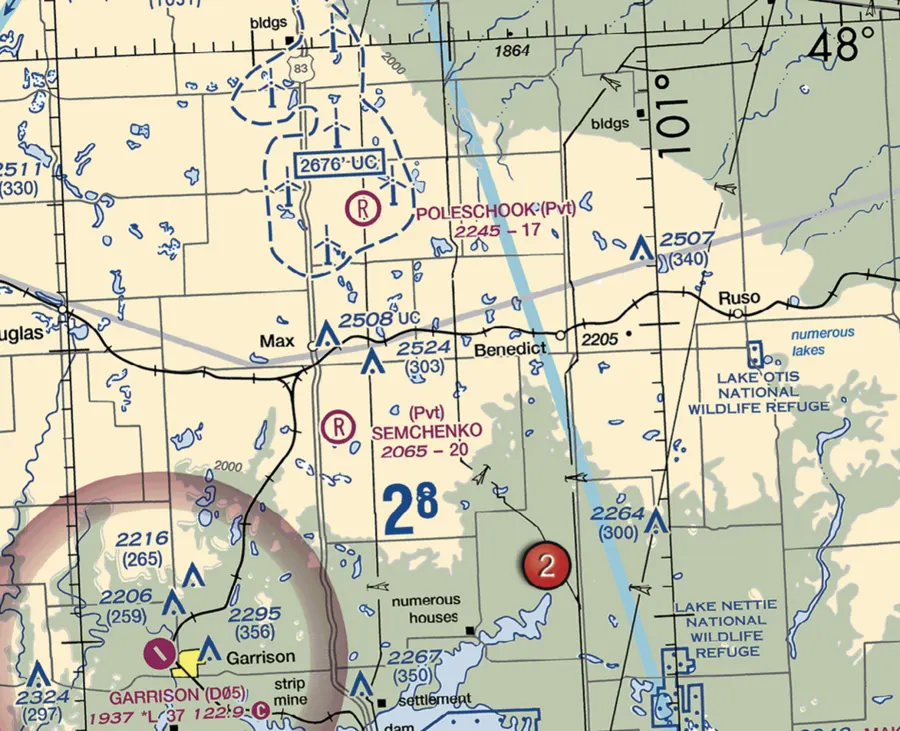 FAA Figure 21 excerpt with obstacle heights shown as MSL tops and AGL heights in parentheses
The excerpt above shows the pattern: 2524 (303) means a top at 2,524 feet MSL on a structure 303 feet tall, and the large 28 in the grid square is a Maximum Elevation Figure of 2,800 feet MSL.
Why does it matter for a drone?
Because your limit moves with the ground. Flying from a valley up a hillside at a steady 400 feet AGL means climbing in MSL. And a tall structure changes the limit: §107.51 allows flight within a 400-foot radius of a structure up to 400 feet above its top. Near the 690-foot tower above, that is up to about 1,090 feet AGL for an inspection, while still respecting airspace and cloud clearance. The 400 feet post explains that rule.
Cloud clearance mixes the two. A METAR cloud base is AGL, so a ceiling at 800 feet lets you fly no higher than 300 feet AGL, keeping 500 feet below the cloud. The cloud clearance post shows the full table.
What the exam asks about AGL and MSL
Altitude questions sit in the airspace elements under UA.II.A.K1 and in chart reading under UA.V.B.K6. Expect a chart excerpt with a floor or obstacle and answer choices that differ only in AGL or MSL. The Class C post walks through the Savannah figure, and the chart symbols cheat sheet covers the rest of the labels.
The chart talks in MSL, the rules talk in AGL. Translate before you answer.
Practice floors, ceilings and obstacle heights on the chart excerpts the test uses.
Read real FAA figuresFree diagnostic
Airspace is the single densest topic on the test. See what you actually know.
Take the free 10-minute diagnostic