
Drone Flight Hazards: Wires, Plumes, Lasers
The flight hazards the Part 107 test names: guy wires and power lines, exhaust plumes, unmanned balloons, lasers and precipitation static, from the AIM.
Most of what can hit a drone at a few hundred feet is not on any chart. The Part 107 ACS lists the hazards it expects you to know by name under "potential flight hazards", and the descriptions come from the FAA's Aeronautical Information Manual, chapter 7. Before every flight, 14 CFR §107.49 requires you to assess the operating environment, including ground hazards, and these are the ones that catch pilots out.
Why are towers and wires the biggest risk at drone altitudes?
The AIM says many structures that matter are below 500 feet AGL, and particularly below 200 feet, where power lines and antenna towers are often not marked, lighted or charted. It warns about two things in particular:
- Guy wires. Tall skeletal towers are held up by guy wires that are very hard to see in good weather and can be invisible at dusk. The AIM says they can extend about 1,500 feet horizontally from the tower and advises staying at least 2,000 feet away horizontally. For a drone inspecting a tower, that means planning the approach around the anchor points, not just the mast.
- Overhead wires. Power and utility lines cross rivers, canyons, highways and railroads, exactly the features drone pilots like to follow. The AIM notes they may be virtually impossible to see; spherical markers and sequenced white strobes on the towers are clues that a span is there.
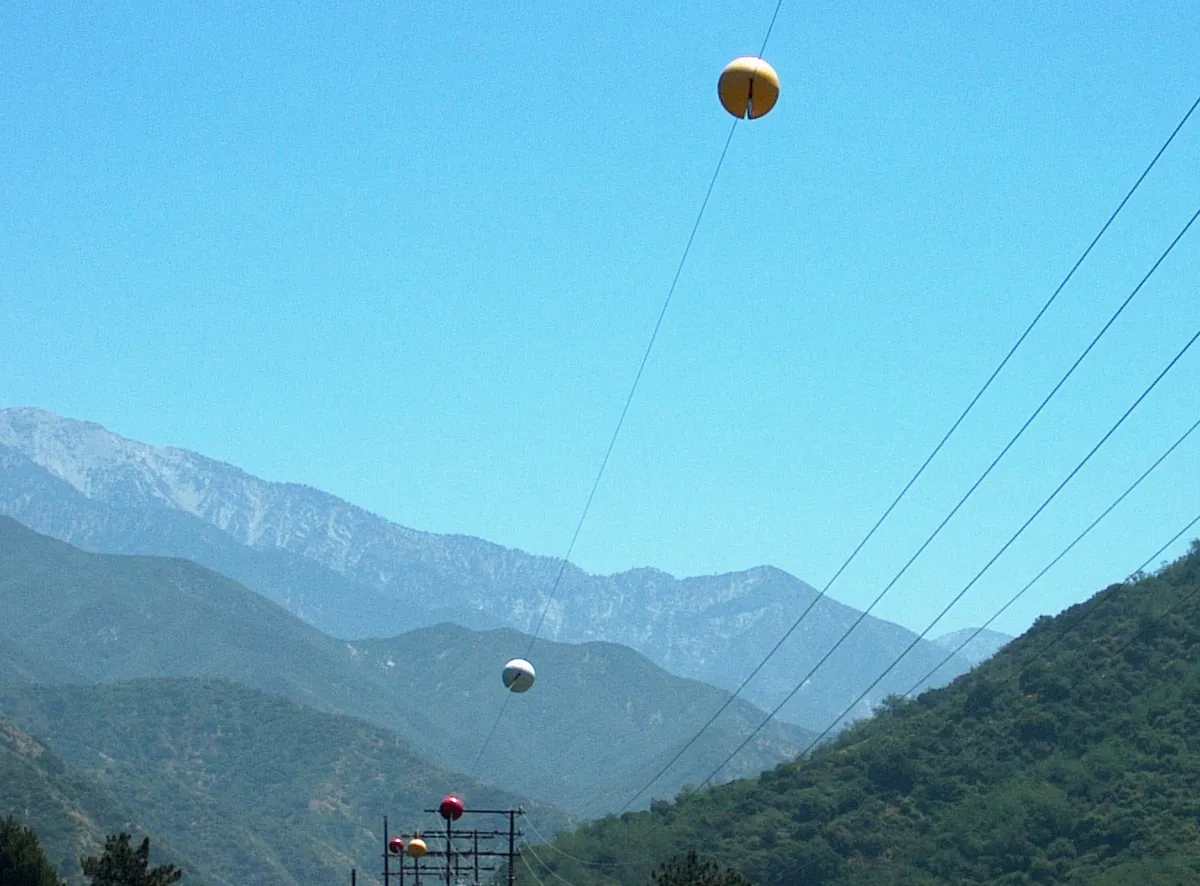 Orange and white spherical markers on power lines crossing a mountain highway in CaliforniaPhoto: Summit Hopper, CC BY 2.0, via Wikimedia Commons
1,500 ft
how far the AIM says a tower's guy wires can extend horizontally from the structure
What do smokestacks and cooling towers do to a drone?
The AIM calls them exhaust plumes: visible or invisible emissions of hot, unstable gases from power plants and industrial facilities. It lists turbulence and vertical shear, reduced visibility, oxygen depletion, contamination and icing as hazards, with upset or damage as possible results, and says the risk is greatest at low altitude in calm, cold air. A drone filming a plant should stay out of the plume and upwind of the stack.
Why avoid flying under a balloon?
Because of what hangs below it. The AIM says most unmanned free balloons carry a payload on a suspension line, a trailing wire antenna or both, often invisible until you are close, so aircraft should stay well clear and never fly beneath one. The FAA's own sample question puts an "unmarked balloon on cable to 3,008 feet MSL" in a chart caution box; the sample questions post walks through it.
What about lasers and static?
Lasers. The AIM notes that laser light shows and other laser events can illuminate aircraft, usually in blue-green but sometimes red, yellow, white or invisible light. Pilots should report an illumination to ATC or Flight Service as soon as possible, with the UTC time, location, altitude and a description.
Precipitation static. The AIM explains that flying through rain, snow, dust or other particles can build up an electrical charge that discharges from the aircraft's extremities. On a manned aircraft it shows up as radio noise. It is on the ACS list, so know the name and the cause.
Birds are a hazard of their own, with their own reporting form and seasons. The bird and wildlife post covers them.
What the exam asks about flight hazards
The element is UA.II.B.K4, potential flight hazards, with sub-elements for accident causal factors, unmanned balloons, emergency airborne inspection, precipitation static, lasers, exhaust plumes and the wire environment. Expect a scenario that names one hazard and asks what to do: stay clear, stay upwind, or report it. Chart symbols for towers and obstacles are in the sectional chart symbols cheat sheet, and what to do when something goes wrong is in the emergencies post.
Assume the wire is there until you have seen where it ends.
The free checklist includes the site survey that catches wires and towers before you launch.
Use the preflight checklistFree diagnostic
Reading about drones is one thing. Passing the Part 107 test is another. See where you stand.
Take the free 10-minute diagnostic