
Fog, Icing and Wind for Part 107
Five kinds of fog, two conditions for icing, and how wind behaves around buildings and mountains: the weather theory behind Part 107 questions.
Thunderstorms get the attention, but fog, ice and wind ground far more drone flights. The Part 107 test covers all three under weather effects on performance, and the answers come straight from the FAA's Pilot's Handbook of Aeronautical Knowledge and Remote Pilot Study Guide.
When does fog form?
The study guide explains that when air cools to its dew point it is saturated, and moisture condenses as fog, dew, frost, clouds, rain or snow. When the temperature and dew point in a METAR are close together, fog and low clouds are likely. The handbook names five kinds of fog:
| Fog | How it forms | What to expect |
|---|---|---|
| Radiation | Clear nights with little or no wind; ground cools fast | Low-lying areas; burns off as the sun rises; under 20 ft thick is ground fog |
| Advection | Warm, moist air moves over a cold surface; needs wind | Common on coasts; above about 15 knots it lifts into low stratus |
| Upslope | Moist, stable air forced up rising ground; needs wind | Can persist for days |
| Steam | Cold, dry air over warm water | Looks like smoke; low-level turbulence and icing |
| Ice | Very cold air, usually -25°F or colder | Mostly arctic regions |
For a drone, fog is a visibility problem first. 14 CFR §107.51 requires at least 3 statute miles of visibility and 500 feet below clouds, and fog can take both away in minutes.
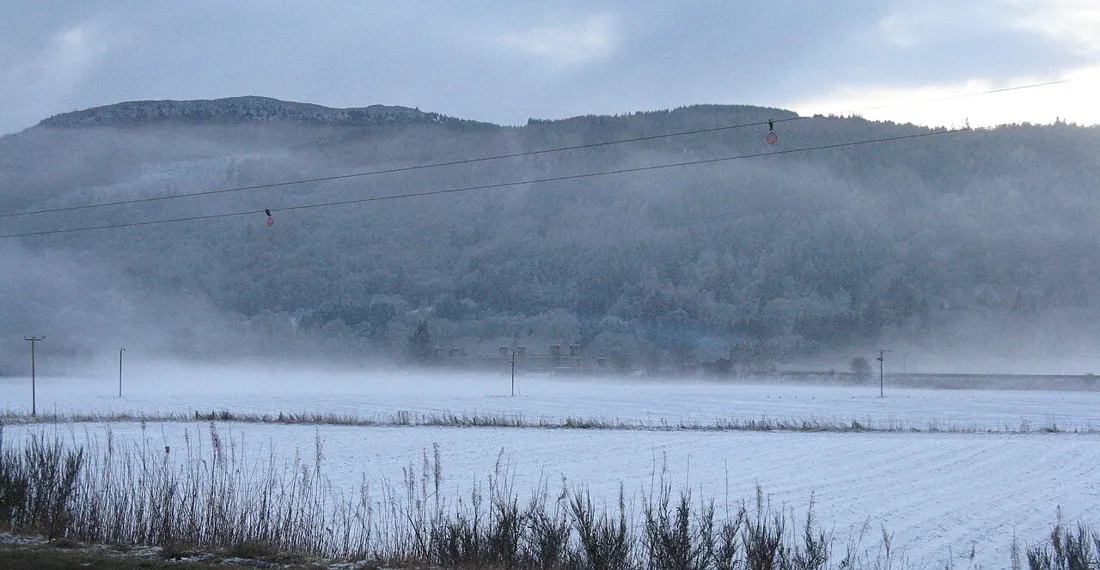 Radiation fog lying in a river valley on a cold morning below a wooded hillside
Radiation fog filling a valley floor on a cold, calm morning. Photo: M J Richardson, CC BY-SA 2.0, via Wikimedia Commons; resized.
3 SM
the minimum flight visibility under §107.51, often the first thing fog takes away
What does it take for ice to form?
The study guide gives two conditions for structural icing: the aircraft must be flying through visible water such as rain or cloud droplets, and the temperature where the moisture hits it must be 0°C or colder. It adds that aerodynamic cooling can bring a surface to 0°C even when the air is a few degrees warmer.
Frost is the ground version. The study guide says frost disrupts the airflow, can drastically reduce lift and increases drag, so a small UA must be thoroughly cleaned of frost before flight. On a propeller, that is a small amount of ice with a large effect.
How does wind behave near the ground?
Around obstructions. Buildings, hangars, bluffs and canyons break up the wind into gusts that change speed and direction quickly. The study guide says the intensity depends on the size of the obstacle and the wind speed, which is why the downwind side of a large building is the roughest place to fly.
Over mountains. Air flows smoothly up the windward side and turns turbulent on the leeward side, where it follows the terrain down. The study guide says wind over 25 knots at mountaintop level suggests turbulence and over 40 knots dictates caution. Standing lenticular clouds, with smooth, polished edges, signal mountain waves and very strong turbulence.
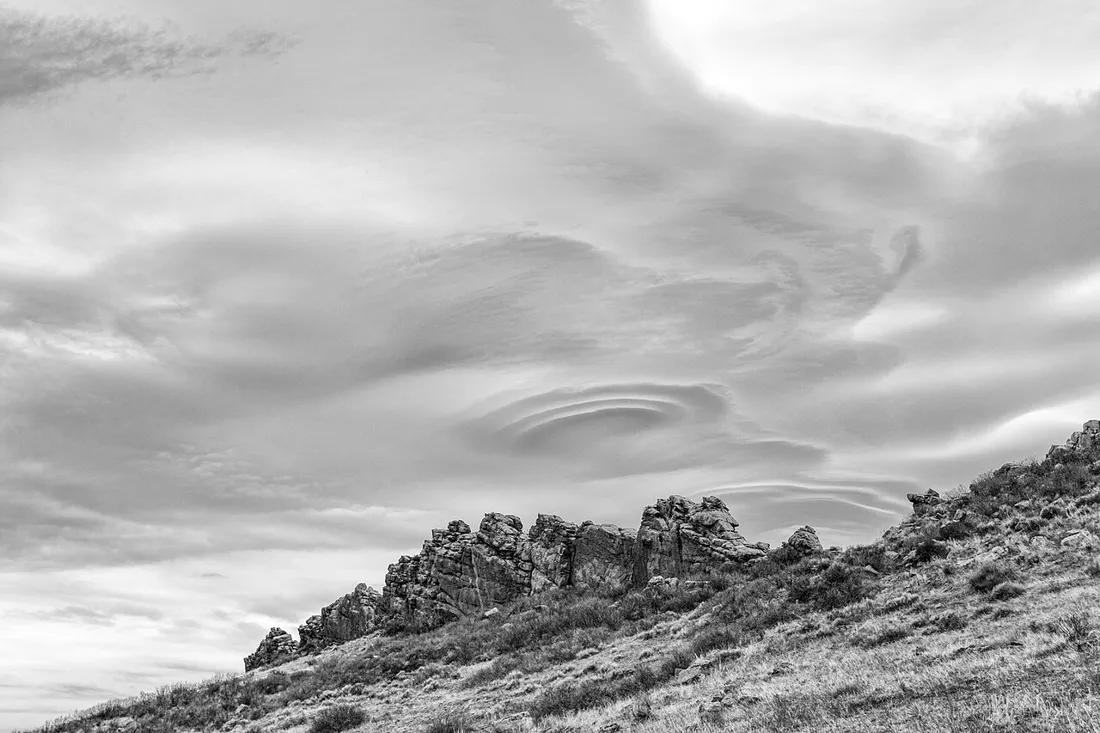 Smooth standing lenticular clouds stacked above a rocky ridge in Colorado
Standing lenticular clouds over a Colorado ridge: smooth edges, little movement, strong wind inside. Photo: Anne Dirkse, CC BY-SA 4.0, via Wikimedia Commons; resized.
Thermal turbulence. AC 107-2A notes that plowed ground, rock, sand and barren land heat the air more than water or vegetation, creating convective currents and bumpy air that affect control.
Low-level wind shear. A sudden change in wind speed or direction over a small area. The study guide links it to passing fronts, thunderstorms, temperature inversions and strong upper winds above 25 knots. The most severe form, the microburst, is covered in the thunderstorm post.
Wind and density altitude stack up. A gusty, hot afternoon at a high site leaves less thrust in reserve for each gust. The density altitude calculator shows how much the air itself has already taken.
What the exam asks about fog, icing and wind
These are sub-elements of UA.III.B.K1: wind and currents (b), icing (g), fog (i), and ceiling and visibility (j). Expect a description of conditions and a question about the result: which fog forms over a coast with a light sea breeze, what two things icing needs, or where the worst turbulence near a mountain is. The weather sources post covers where to find the observations.
Close temperature and dew point mean fog. Visible moisture at freezing means ice. The lee side means turbulence.
Decode a METAR and see the temperature and dew point spread, the cloud base and your legal altitude.
Check today's conditionsFree diagnostic
Weather questions trip up more test-takers than any other area. Find out if you're ready.
Take the free 10-minute diagnostic