
Density Altitude and Drone Performance (2026 Guide)
Two numbers define a standard day. Everything about density altitude comes from how far the real day drifts from those two numbers.
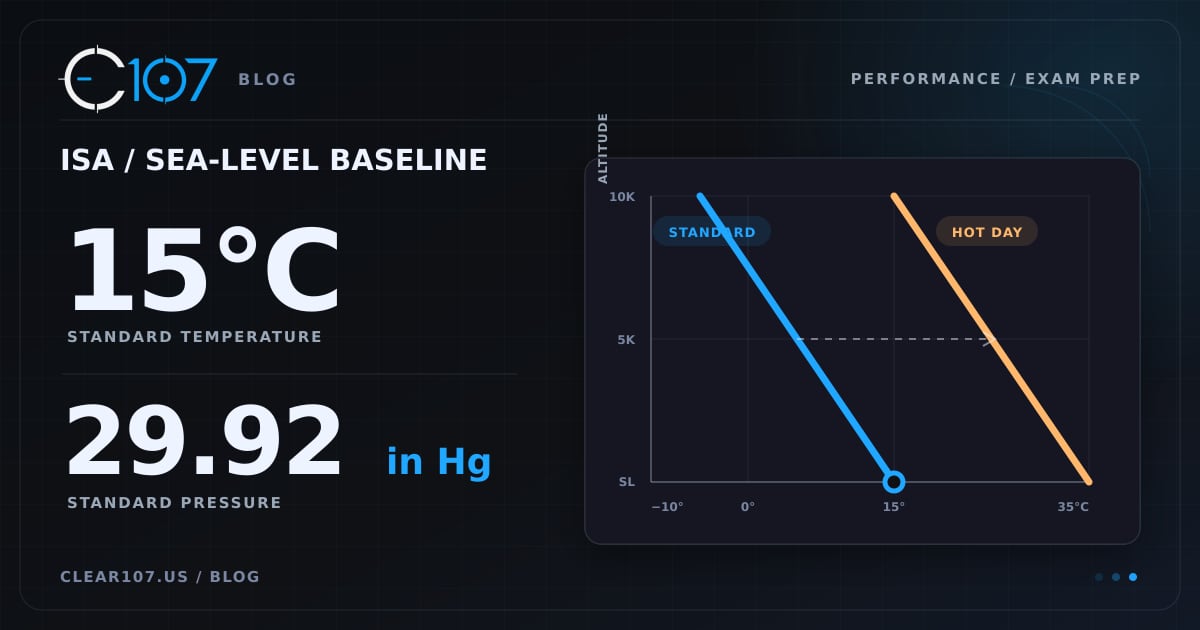
A drone that climbs fine at sunrise can struggle to clear the same rooftop by mid-afternoon with the same battery and the same payload. Nothing about the aircraft changed. The air did. Density altitude is the concept that explains why, and it's tested for the same reason it matters in the field: it directly changes how much lift and thrust you actually have, not just how the number reads on a chart.
Density altitude isn't a separate topic from performance. It's the correction you apply before any performance number means anything.
The two numbers everything is measured against
Every performance figure a manufacturer publishes assumes a baseline: the International Standard Atmosphere (ISA) at sea level.
15°C
the ISA standard sea-level temperature
29.92 in Hg
the ISA standard sea-level pressure
Pressure altitude is what you get by setting an altimeter to 29.92 and reading the result; it strips out the day's actual barometric pressure and expresses altitude purely against that fixed reference. Density altitude goes one step further: it takes pressure altitude and corrects it for the day's actual temperature. On a day that happens to match the standard exactly, density altitude and pressure altitude are the same number. Almost no real day matches it.
The rule that decides which direction performance moves
Three conditions push density altitude up, and all three push it the same direction: worse performance.
High temperature. Warmer air is less dense. Less dense air produces less lift for the same airspeed and less thrust for the same propeller RPM.
High field elevation. Less atmosphere is pressing down, so the air is thinner to begin with, before temperature even enters the picture.
High humidity. Water vapor is lighter than the nitrogen and oxygen it displaces, so humid air is measurably less dense than dry air at the same temperature and pressure, not more.
The memory rule used throughout Clear107's handbook is High-High-High: high temperature, high elevation, high humidity all raise density altitude, and higher density altitude always means reduced performance, never improved performance.
None of the three factors need to be extreme individually. A moderately hot, moderately humid day at a moderate-elevation launch site can add up to a density altitude several thousand feet above the field's actual elevation, which is exactly the kind of scenario the exam likes to test.
Why this is a Part 107 topic, not just a general-aviation one
It's tempting to treat density altitude as a manned-aircraft concept that got carried over into the drone exam by inertia. It didn't. A small UAS depends on the same physics: propeller efficiency, motor thrust, and battery-to-thrust conversion all degrade in thinner air exactly the way a fixed-wing's lift and engine power do. A multirotor that hovers comfortably at a cool, low-elevation site can have meaningfully less climb margin at a hot, high-elevation one carrying the same payload, and manufacturer performance data (not a pilot's memory of how the aircraft flew last time) is the only reliable way to know how much margin is actually left.
The mistake this topic sets up
Weather and Loading and Performance combined make up a small share of the Part 107 blueprint, which makes them easy to under-study once a candidate notices the percentage. Density altitude specifically resists that shortcut: it isn't a fact to memorize once, it's a relationship (temperature, elevation, and humidity all pushing the same direction) that shows up disguised as scenario questions about hot-day rooftop launches, high-elevation survey missions, or humid coastal flights. Recognizing the High-High-High pattern under those different wordings is the actual skill being tested.
Clear107's weight planner estimates aircraft, battery, and payload margin so you can see how a hot, high, or humid day eats into it before you launch.
Check your loading marginFree diagnostic
Reading about drones is one thing. Passing the Part 107 test is another. See where you stand.
Take the free 10-minute diagnostic