How to Get Your Part 107 License, Step by Step
The FAA's seven steps to a remote pilot certificate: FTN, booking and passing the test, IACRA, TSA vetting, the card. Plus the cost and the pilot shortcut.
What people call a Part 107 license is officially a Remote Pilot Certificate, and you need one to fly a drone for work, for a client or for a business. The FAA's Become a Drone Pilot page lays out the whole process in seven steps. This post walks through them in order, with the details that hold people up.
Who can get a Part 107 certificate?
The FAA lists four conditions. You must:
- be at least 16 years old;
- be able to read, speak, write and understand English;
- be in a physical and mental condition to safely fly a drone;
- pass the initial knowledge exam, "Unmanned Aircraft General – Small" (UAG).
There is no flight test and no medical certificate. The eligibility and recency post covers the rules behind each condition.
The seven steps
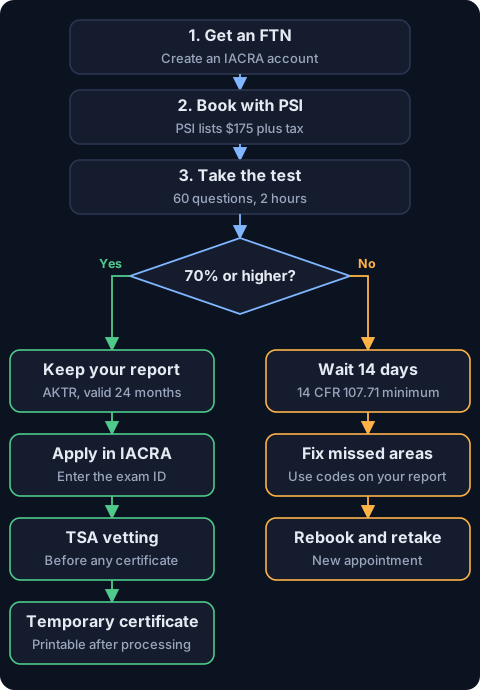 Flowchart from FTN and PSI booking to the test, then IACRA and TSA vetting if you pass or a 14 day wait and retake
- Get an FAA Tracking Number (FTN). Create a profile in IACRA, the FAA's online application system. Your FTN comes with the profile, and you need it before you can register for the test.
- Book the test. Schedule an appointment with an FAA-approved Knowledge Testing Center, run by PSI. Bring a government-issued photo ID on the day.
- Pass the UAG knowledge test. The test has 60 questions, two hours, and a passing score of 70%.
- Apply in IACRA. Start a new application, choose Pilot, then Remote Pilot, and fill in FAA Form 8710-13. When prompted, enter the 17-digit Knowledge Test Exam ID from your test report. The FAA notes that the test can take up to 48 hours to appear in IACRA.
- TSA security check. Once the TSA background check is complete, you get an email with instructions to print a temporary certificate from IACRA.
- Permanent card. The FAA mails the plastic certificate once its internal processing is done.
- Carry it. Your certificate must be easily accessible whenever you fly. The post on showing your certificate to police explains who can ask to see it.
48 hours
how long the FAA says a passed test can take to appear in IACRA
What does it cost?
The main cost is the test. PSI listed the FAA knowledge test at $175 plus applicable tax as of September 17, 2026; check the current price when you book. The FAA's seven steps list no separate fee for the IACRA application or the TSA check. The exam cost page covers budgeting, including what a retake adds.
Already a manned pilot? There is a shorter path
If you hold a pilot certificate under 14 CFR Part 61 and completed a flight review within the previous 24 months, you skip the knowledge test:
- Create an account on the FAA Safety Team (FAASTeam) website.
- Complete the online course Part 107 Small UAS Initial (ALC-451).
- Fill in Form 8710-13 in IACRA.
- Validate your identity with a Flight Standards District Office, a designated pilot examiner, an airman certification representative or a flight instructor. Bring the form, proof of your flight review, photo ID and the course completion certificate.
The FAA notes that flight instructors can process the application but cannot issue a temporary certificate. The other three can, and the permanent certificate follows by mail.
Failing is not the end of it. Under 14 CFR §107.71 you can retake the test 14 calendar days after a failed attempt. The failed exam post covers the retake plan.
How do you keep the certificate current?
The certificate itself does not expire, but to use it you must complete free online recurrent training every 24 calendar months, as §107.65 requires. The renewal post explains how the 24-month clock counts, and the currency calculator gives you the exact date.
What to study before you book
The FAA lists the test areas: regulations, airspace and flight restrictions, weather, loading and performance, emergency procedures, crew resource management, radio communication, drugs and alcohol, decision-making, airport operations, maintenance and preflight, and night operations. Regulations carry the most weight on the current blueprint.
About one in six candidates failed in 2025, according to the FAA's own statistics, as the pass rate post shows. The cheapest way to avoid paying for a second attempt is to find your weak areas first, then book. The test day checklist covers what to bring and what happens at the testing center.
FTN first, test second, IACRA third. Most delays come from doing these out of order.
Still deciding? Read is Part 107 worth it for what the certificate opens up and what it costs.
The free 20-question diagnostic scores you by exam area in a few minutes.
Check if you are ready before paying $175Free diagnostic
Reading about drones is one thing. Passing the Part 107 test is another. See where you stand.
Take the free 10-minute diagnostic