How to Read a METAR for the Part 107 Exam (2026 Guide)
A METAR looks like line noise until you know the format. Once you do, it's the fastest go/no-go check in aviation, and a real Part 107 exam requirement.
A METAR is a routine aviation weather report: a fixed-format string of codes that packs station, time, wind, visibility, sky condition, temperature, and pressure into one line. It looks unreadable the first time you see one. It is completely mechanical once you know the format, which is exactly why the Part 107 exam tests it: this isn't trivia, it's a real skill you'll use before every flight.
A METAR isn't a puzzle to memorize. It's a fixed sequence of groups, in a fixed order, every time. Learn the order once and every METAR you'll ever read follows it.
A real METAR, decoded group by group
Take this one apart:
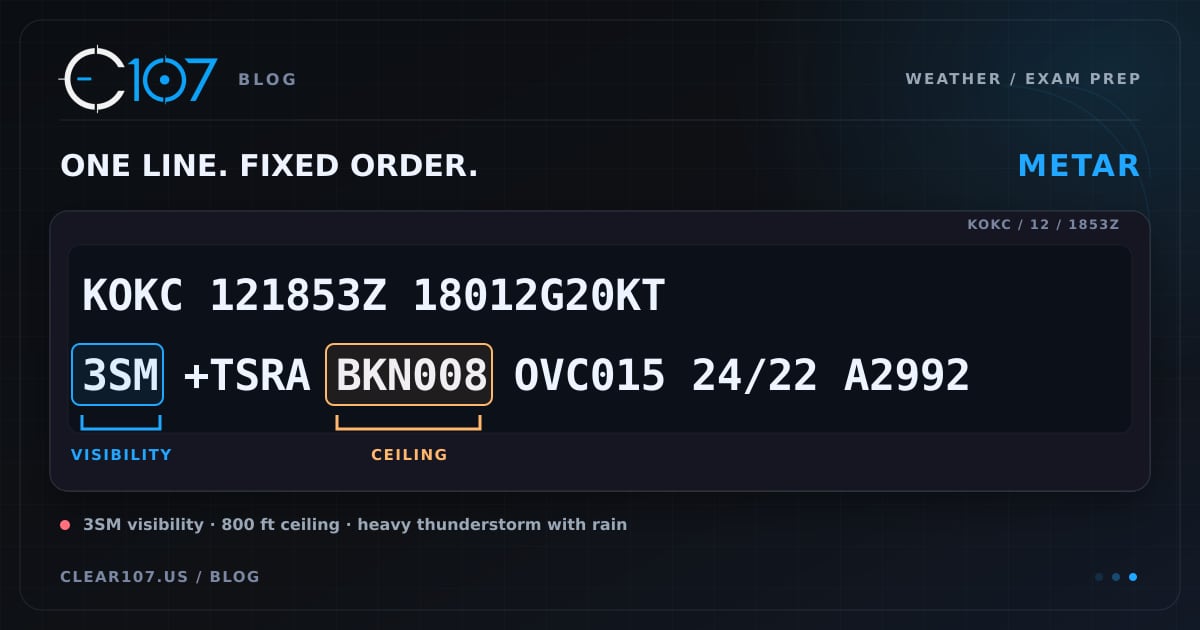
KOKC 121853Z 18012G20KT 3SM +TSRA BKN008 OVC015 24/22 A2992
KOKC: the station identifier. Four letters, always starting with K for the continental US.
121853Z: the observation time. Day 12 of the month, at 1853 Zulu (UTC). Not local time; this trips up more candidates than any other group.
18012G20KT: wind from 180 degrees true, at 12 knots, gusting to 20. A three-digit direction plus a two-digit speed, with an optional gust group.
3SM: visibility, in statute miles. Three miles here. Watch for M (less than) and P (greater than) modifiers, as in P6SM.
+TSRA: weather phenomena. The + means heavy. TS is thunderstorm, RA is rain. Codes combine: TSRA is a thunderstorm with rain, not two separate things.
BKN008 OVC015: sky condition. Broken clouds at 800 feet, overcast at 1,500 feet (the numbers are in hundreds of feet). The lowest broken or overcast layer is the ceiling, here that's 800 feet.
24/22: temperature over dewpoint, in Celsius. A gap this small (2 degrees) means high fog risk.
A2992: altimeter setting, 29.92 inches of mercury.
Reading order matters less than group recognition. On the exam, you don't need to recite a METAR front to back; you need to correctly identify what a specific group means when a question isolates it.
Why this specific METAR would end a Part 107 flight
Every value in that string maps to a real legal limit under 14 CFR §107.51:
3SM
minimum flight visibility required to operate
500ft
minimum vertical distance below clouds
This METAR fails on three separate grounds. Visibility is exactly at the 3SM floor with a thunderstorm actively reducing it further. The 800-foot ceiling means you cannot legally climb anywhere near your normal operating altitude while staying the required distance below clouds. And a thunderstorm in the vicinity is an automatic no-go regardless of the other numbers: convective activity brings wind shear and turbulence no small UAS is rated for.
A candidate who can decode the string but doesn't connect it to the operating limitation gets the exam question wrong anyway. The decoding is the easy half.
The groups that actually decide go or no-go
Not every group in a METAR carries equal weight for a Part 107 decision. In practice, four groups do almost all the work:
- Visibility: below 3SM is a hard no, no exceptions.
- Ceiling (the lowest BKN or OVC height): below roughly 900 feet leaves no legal margin for the 500-foot cloud clearance rule at any reasonable operating altitude.
- Wind, including gusts: not a regulatory limit, but most small UAS have real manufacturer wind limits well under what a manned aircraft would consider routine.
- Present weather codes: TS, FZ, and heavy-intensity (+) prefixes are near-automatic no-go regardless of what the other groups say.
Everything else (temperature, dewpoint, altimeter) matters for judgment and for other exam questions, but rarely changes the go/no-go call by itself.
Practice on real METARs, not flashcards
Reading about METAR format and being fast at decoding one under exam time pressure are different skills. The only way to close that gap is repetition against real strings, not memorized examples.
Clear107's weather tool breaks down a real METAR group by group, flags the exact Part 107 thresholds each value trips, and explains the drone-specific risk behind each code.
Try the METAR decoderFree diagnostic
Weather questions trip up more test-takers than any other area. Find out if you're ready.
Take the free 10-minute diagnostic