Low Clouds Can Cap You Far Below 400 Feet
Part 107 requires 500 feet below clouds. With a cloud base under 900 feet AGL, that rule, not the 400-foot limit, sets your ceiling. At 500 feet, it is zero.
Most people remember 400 feet as the Part 107 ceiling. On a low-cloud day, the real ceiling is set by a different number in the same rule: you must stay at least 500 feet below the cloud. Whenever the cloud base is below 900 feet above ground level, that requirement caps you below 400 feet. At a 500-foot base or lower, there is no legal altitude left without a waiver.
What are the cloud clearance rules?
14 CFR §107.51(d) requires the small unmanned aircraft to stay at least 500 feet below the cloud and at least 2,000 feet horizontally from the cloud. §107.51(c) adds a minimum flight visibility of 3 statute miles, observed from the location of the control station.
500 ft
minimum distance below a cloud under §107.51(d)
How do you work out your actual ceiling?
Take the lower of two numbers: 400 feet AGL, or the cloud base minus 500 feet. The two meet at a 900-foot cloud base. Above that, the 400-foot limit binds. Below it, the cloud rule does.
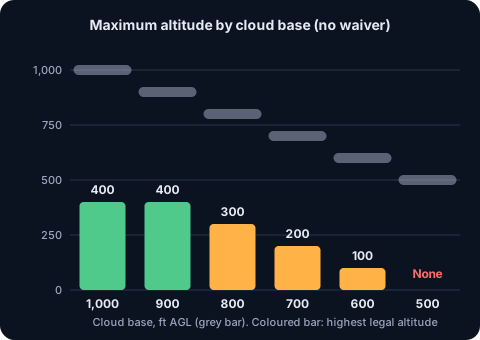 Bar chart of max drone altitude by cloud base: 400 ft at 900 or higher, then 300, 200, 100, and none at 500
| Cloud base (ft AGL) | Cloud base minus 500 | Highest legal altitude |
|---|---|---|
| 1,000 | 500 | 400 (the 400-foot limit binds) |
| 900 | 400 | 400 |
| 800 | 300 | 300 |
| 700 | 200 | 200 |
| 600 | 100 | 100 |
| 500 or lower | 0 or less | None without a waiver |
Where does the cloud base number come from?
A METAR reports cloud heights in hundreds of feet above ground level at the reporting station. BKN007 means a broken layer at 700 feet. The METAR post decodes the full report. The station may not be where you are flying, and cloud bases can be lower over your site than at the airport, so treat the reported number as a starting point.
The rule measures from the cloud, wherever it actually is. A METAR is evidence of where the cloud is, not a legal ceiling in itself.
Does the structure exception help near clouds?
No. The structure exception in §107.51(b) lets you go higher than 400 feet AGL near a structure, but the cloud clearance and visibility rules in §107.51(c) and (d) still apply. On a 700-foot cloud base next to a 400-foot tower, you are still capped at 200 feet AGL by the cloud rule.
Can you get a waiver for cloud clearance?
Yes. All of §107.51, including the visibility and cloud clearance minimums, is on the list of waivable rules in §107.205. Without one, the table above is the limit. The 400-foot post covers the altitude side of the same section.
A worked example
The nearest METAR reads OVC006, an overcast layer at 600 feet. Your client wants a shot from 200 feet. The cloud rule caps you at 100 feet AGL, so the shot does not work today, whatever the 400-foot limit allows. If the layer lifts to 800 feet, you can fly up to 300 feet, and the 200-foot shot becomes legal.
What this means for the exam
Expect a METAR with a low ceiling and a question about the maximum altitude. Convert the cloud height to feet, subtract 500, and compare it with 400. Take whichever is lower. Also check the visibility group: anything less than 3 statute miles means no flight under Part 107, whatever the clouds.
The handbook covers cloud clearance under UA.I.B.K21 and weather effects under UA.III.B.K1.
To see whether a low ceiling is coming later in the day, read the airport's forecast: the TAF guide decodes each change group.
Cloud bases in reports are AGL while chart altitudes are mostly MSL, which the AGL vs MSL post untangles. Fog is the usual reason a ceiling drops fast, as the fog, icing and wind post explains.
The free diagnostic includes weather questions and scores you against the current blueprint.
Practice weather and METAR questionsFree diagnostic
Weather questions trip up more test-takers than any other area. Find out if you're ready.
Take the free 10-minute diagnostic