Reading Airspace on a Sectional Chart (2026 Guide)
Airspace questions aren't about memorizing definitions. They're about reading a chart and knowing, in seconds, whether a spot requires authorization.
Airspace classification is a chart-reading skill dressed up as a knowledge topic. The exam doesn't ask you to define Class C airspace from memory; it shows you a piece of a real sectional chart and asks what's true at a specific point on it. Get the line style and color right and the answer falls out. Get them confused and you'll answer confidently and wrong.
The chart isn't testing what you memorized. It's testing what you can recognize under time pressure, on a figure you've never seen before.
The four symbols that decide almost every airspace question
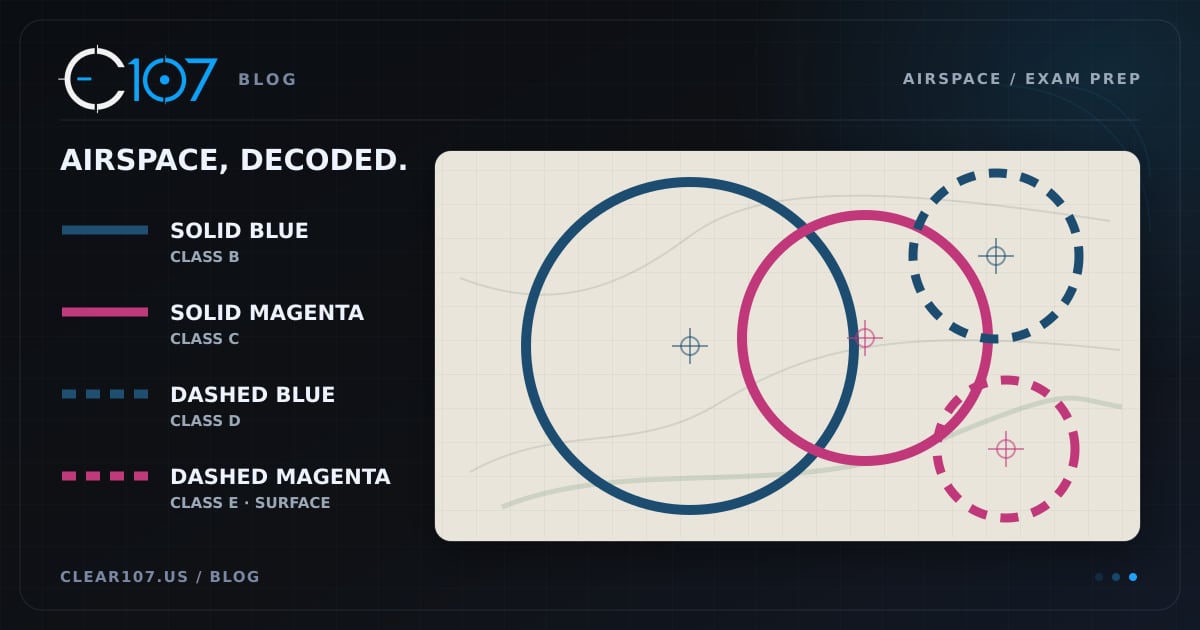
Sectional charts encode airspace class through line color and line style, and the exam leans hard on four visual patterns:
Solid blue lines, often with blue shading: Class B airspace. This surrounds the busiest airports in the country in a stepped, "upside-down wedding cake" shape.
Solid magenta lines, often with magenta shading: Class C airspace. Two concentric rings around a towered airport with radar services.
Blue dashed circle: Class D airspace. A smaller ring around a towered airport, typically from the surface up to around 2,500 feet above the airport elevation.
Magenta dashed circle: Class E airspace designated to the surface. This one trips up more candidates than any other symbol, because it looks similar to Class D at a glance but means something different: a non-towered airport with an instrument approach, where controlled airspace still reaches the ground.
Everywhere else, without a shaded vignette or dashed line at a given point, is Class G: uncontrolled airspace, running from the surface up to whatever controlled layer sits above it.
4,000ft AGL
the standard ceiling of Class C airspace above the primary airport
2,500ft
the approximate ceiling of Class D airspace above the airport elevation
Why the symbol determines your legal move
Every one of those symbols maps to a real requirement under 14 CFR §107.41: before operating in Class B, Class C, Class D, or Class E airspace designated to the surface, you need prior authorization. That authorization is typically obtained through LAANC (Low Altitude Authorization and Notification Capability) at participating facilities, near-instantly for altitudes and locations already pre-approved.
This is where a lot of exam answers, and real-world flights, go wrong: none of this depends on how high you're flying. A drone at 40 feet AGL inside a Class C shelf still needs authorization. Private property doesn't remove the requirement either. The chart symbol at your launch point decides the rule, not your intended altitude.
"Uncontrolled" is not the same as "unregulated." Class G airspace doesn't require prior authorization, but every other Part 107 operating rule (registration, remote pilot certification, operating limitations under §107.51) still applies there exactly as it does anywhere else.
The mistake that costs the most points
Candidates who study airspace as a list of altitude definitions can usually recite that "Class B goes up to 10,000 feet MSL" and still get a figure question wrong, because the exam doesn't ask for the definition. It shows a chart excerpt and asks what's true at a circled point on it. That requires pattern recognition: can you tell a dashed blue circle from a dashed magenta one at a glance, under time pressure, on a chart you've never seen?
Solid versus dashed matters as much as blue versus magenta. Mixing up "Class C is solid magenta" with "Class D is dashed blue" is one of the single most common wrong answers on this part of the test, precisely because the two symbols share a color family with two other symbols that mean something different.
Practice on real FAA figures, not just descriptions
Reading about chart symbols and correctly identifying one on an unfamiliar FAA figure, in the seconds you get on a real exam question, are different skills. The only way to close that gap is repetition against the actual figures the FAA uses.
Clear107's chart tool uses the same FAA figures as the knowledge test, with clickable hotspots that show you exactly which Part 107 rule applies at each symbol.
Practice on real sectional chartsFree diagnostic
Airspace is the single densest topic on the test. See what you actually know.
Take the free 10-minute diagnostic